Cleveland Heights
St. Paul's
Episcopal Church
St. Paul’s Episcopal Church, Cleveland Heights, was part of a growing trend of several Cleveland congregations in the 1920s that followed the exodus of its members from the inner city to the outlying communities. In 1927, work began on what Cleveland architects Walker & Weeks envisioned for a sprawling Gothic-inspired complex to replace St. Paul’s high Victorian edifice along Cleveland’s shrinking millionaire’s row on Euclid Avenue. Work continued until a temporary church (originally designed as a parish hall) and the striking 150-foot tower were completed.
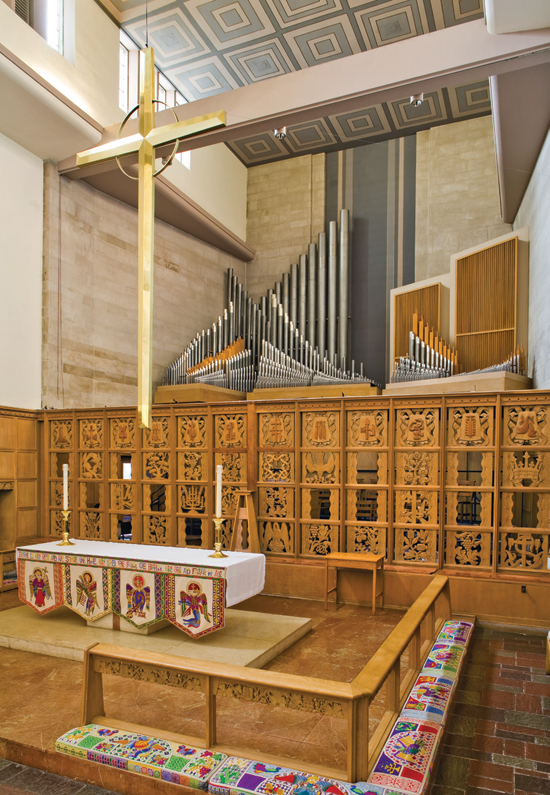
On the heels of the Great Depression and World War II, the main sanctuary and chapel were never completed. Lower portions of the unfinished sanctuary were again started in 1941, but it remained incomplete for another decade. J. Byers Hayes, architect for Walker & Weeks, revisited the original design and modified the plans to be in line with modern aesthetic preferences in the years leading up to its completion. Walter Holtkamp urged the building committee and architect to move the planned organ from side chambers to a freestanding location in the center of the chancel. The result was a progressive, case-less, architectural organ statement where form follows function in the distinctly modern English environment. The three-manual 1952 Holtkamp (Opus 1657), though still “modern” to some who may recall the era during which it was installed, is an increasingly rare tonally-intact example of the late work of Walter Holtkamp. The organ deserves further study and comparison with instruments of the American Classic ideology. It was designed in conjunction with Walter Blodgett, then organist of St. Paul’s. The instrument has a plethora of well-defined choruses on a mixture of electropneumatic and slider chests, arranged to make an impressive and systematically artful design. The inclusion of a 32¢ Pedal Polyphone and mixtures developed and imported from English organbuilder John Compton reflect that experimentation and new methodologies were always foremost in Holtkamp’s work.
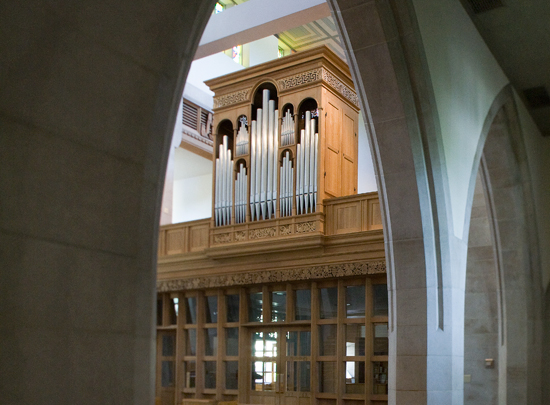
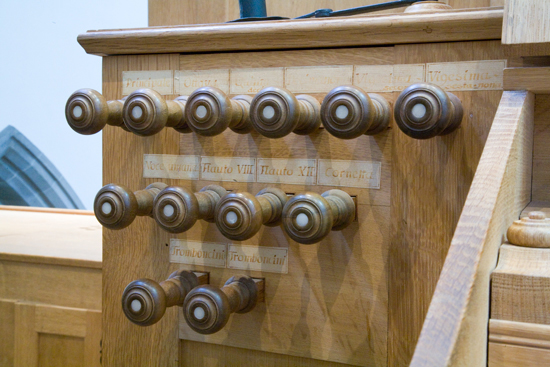
Though Arthur Quimby, Grigg Fountain, Fenner Douglass, and Walter Blodgett are gone, music still continues to flourish and grow in Cleveland. Karel Paukert became director of music at St. Paul’s in 1979, and in 1986 the two-manual Gerhard Hradetzky organ was installed. The design of the Hradetzky organ is based on late 18th-century organs of the Pistoia region of Tuscany, Italy, with some South German and Austrian influences. The organ’s choruses are conceived in ripieno style, a sonorous layering of higher pitches to produce a variety of harmonic combinations. It is tuned in a form of modified meantone tailored exclusively to 18th and 19th century literature. Characteristically Hradetzky had included a Campanelli (25 tuned glockenspiel-like bells), a Usignoli (bird call), and Timpani. David Schrader is equally at home with both organs; however, we are sure you will walk away with a smile after hearing an operatic-like Italian Offertorio!

|