St. Procop Church
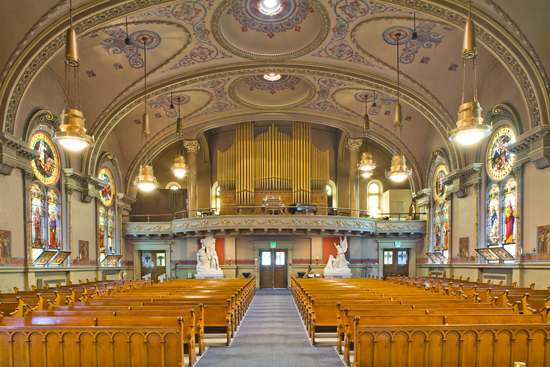
St. Procop Church, our next venue, has been marked for consolidation and closure next summer. Randy Bourne will play the convention recital, our group being one of the last to enjoy the structure that faces an unpredictable future. The highly-decorated Byzantine/ Romanesque edifice was begun in 1899 and designed by Cleveland architect Emil Uhlrich. In 1913, a new two-manual, 1913 Votteler-Hettche tubular-pneumatic organ was installed and dedicated by Edwin Arthur Kraft. Save for electrification of the action, the organ is tonally intact and perhaps the largest extant instrument from a short-lived period of the company’s history under this name. Built in a transitional era of tonal design, the organ has a grand, roaring tutti that is large, but not muddy, as one would expect, given the heroic pipe scales and linen-lead diapason choruses. The colorful reeds hint toward the orchestral preferences soon to dominate organbuilding while stops like the Salicional (Keraulophone construction) and Quintadena are reminiscent of 19th-century instruments. A unique feature of this instrument is the enclosed Great Unda Maris—the stop that activates a pneumatic slider motor under the toe board of the Melodia decreasing wind conveyance as it draws the Dulciana at unison pitch creating a celeste stop. While at least two other Votteler-Holtkamp-Sparling organs are known with a similar mechanism, we find here a means of adjusting each note of the celeste via large turn screws.

|